I’m taking an online class, Interactive Computer Graphics, and most of the lecture videos have been pretty cognitive. They start off with an example of an issue that users experience in a normal computer interface during a relatively standard process and how graphics that are designed to engage more specifically with certain tasks can create a better visual experience. They later progress into distinct techniques and tools to achieve such enhancements.
For instance, one of the first topics was regarding typical scrolling functionality in browsers and how it becomes particularly problematic with large documents. In addition to supplementing, or straight up replacing, a scroll bar with a mouse over control, solutions include the ability to change scrolling speed based on mouse position (center vs ends), as well as implement a corresponding automatic zoom to navigate through sections quicker while maintaining readable chapter headers to maneuver effectively. The same principle was applied to a map where the user may need to move over a relatively large area quickly while being able to slow down and zoom in when reaching the desired location.
A recent lesson was taking a 2D shape similar to a simple character drawn in Paint and  being able to manipulate it as if you were picking up a real object–stretch, rotate dimensionally, and interact with the figure, like having it wave, aka, basic animation without generating hundred of individual frames to imitate motion. The professor proceeds to sketch a mundane worm and moments later, by selecting a couple points of movement, it’s crawling across the screen. Or, below, a humpty-dumpty character kicks a rock.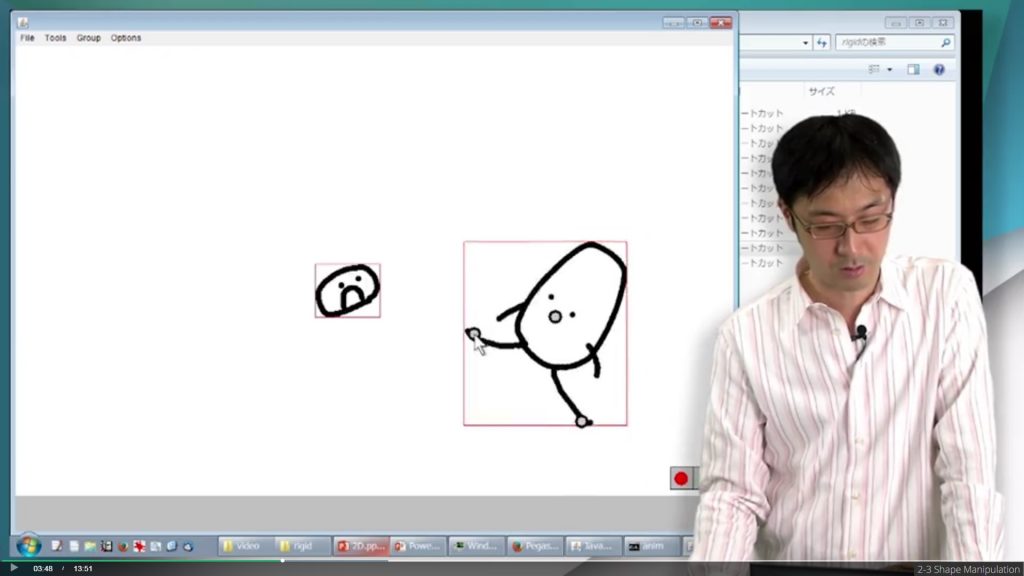
The lecture continues into the research a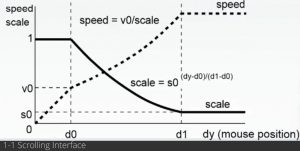 nd scientific/mathematical/or programming algorithms that designed the particular software/concept/technique of focus. The instructor ends the material with a statement such as, “I recommend that you take a look at the original paper published in 2008 titled […]”.
Despite not being able to implement immediate application of the course logic…or articulately detail the equations from memory…I close the video every time with a sense of overall comprehension where I feel confident I could discuss the principles intelligently with proper terms and nomenclature. My mental acuity of the depth and delivery of the material is not, however, parallel with the scope of what the assignments seem to expect.
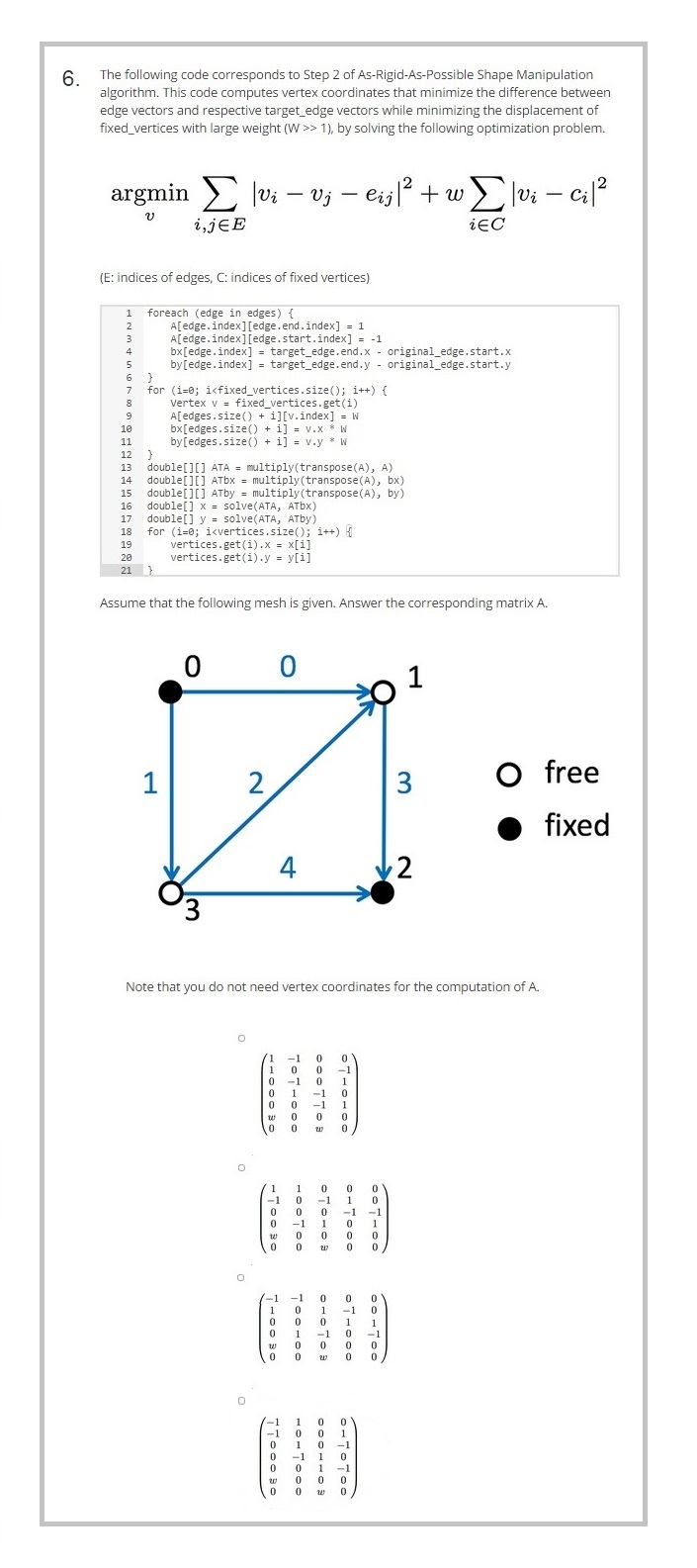
Remember that cute rock kicking egg-figure? Three minutes of that 14-minute lecture segment was related to the mathematical condition behind the method. Keep in mind, also, that nowhere in the series or in the published paper is there the smallest snippet of programming code. Yet, below is an actual question from the chapter quiz that is supposed to equitably gauge my understanding of the module. Am I being absurd that the word that comes to mind when I broach these assessments is: “Dafuq?”
>>side note: if interested in properly judging my reaction, this is the project publication.