

Halloween 2018 is over a week past, but in this lull before the looming holiday season that has already filled the store shelves, I’m continuing to slowly work on my stash of candy. Also, having grabbed some great after-season purchases at the pop-up Halloween store, I still have a bit of the ghouly spirit.
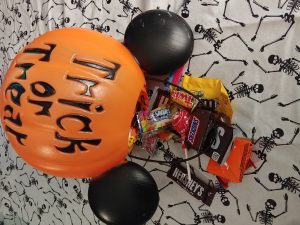
This year was the scene of an interesting marketing ploy as well. In response to a survey that answered 90% positively to Americans liking the option to trade in their undesired candy, and 4 out of 5 of those choosing that trade to be for peanut butter cups, Reese’s introduced a vending machine of sorts to fulfill both of these desires. Well, 10,000 cups worth of discarded treats.
In a conversation about this strategy, the question arose of what Reese’s planned on doing with the rejected confectionery. What unfortunate soup kitchen was going to get stuck with the mini tootsie roll, whopper, and milk dud refuge that would otherwise linger until stale at the bottom of the bucket.
“Have you ever seen the huge bails of clothes at Salvation Army? Probably 6′ cubes. Stuffed in the middle is a bag of poop candy.”
“The bails are real-I used to shop from them in Africa! I still have and wear a Ralph Lauren dress I bought from a ‘dead yovo’ market. ‘Yovo’ is white people and they say dead yovo piles because they thought the only way people would give up their clothes is if they died.”
‘Dead White People’s Clothes‘ is a pretty interesting article about the impact of donated clothes on the fashion industry in Africa.
One news source has indicated that the exchanged candy would be donated with a matched quantity of cups. A couple of questions I still have though is if the conversion rate of ‘inferior candy’ to Reese’s was 1-1 by volume, and how did the machine confirm it was in fact intaking candy versus any other food (or nonfood) item?