
Enterprise Claims Knowledge Hub
Overview
The Enterprise Claims Knowledge Hub was designed to centralize critical claims resources, training materials, reference tools, and operational guidance into a single, intuitive destination for associates. The initiative focused on improving information accessibility, reducing search time, and supporting just-in-time learning for thousands of claims professionals across multiple regions and claim handling levels.
Business Challenge
Over time, claims resources had become fragmented across multiple SharePoint sites, regional OneNote repositories, training materials, newsletters, and departmental resources.
Each of the 11 regional offices maintained its own collection of reference materials and operational guidance. As employees transferred roles, retired, or changed positions, ownership of content became unclear, resulting in duplicated information, outdated resources, inconsistent practices, and difficulty locating critical job aids.
Associates often needed to navigate through numerous pages and links before finding the information they needed, increasing frustration and reducing productivity.
Project Goals
- Organize a large quantity of resources into a centralized location
- Minimize the number of clicks required to locate information
- Keep associates on a single page whenever possible
- Increase engagement through enhanced interactivity
- Improve visibility of training, operational, and performance support resources
- Reduce time spent searching for information
- Support just-in-time learning and performance
Audience
Primary users included:
- Claims Associates
- Claims Supervisors
- Regional Trainers
- Training & Education Teams
- Claims Management
- Operations Support Staff
The solution needed to support multiple experience levels, claim handling roles, and regional business practices while maintaining a consistent user experience.
Learning & Performance Strategy
This project was approached as a performance support initiative rather than a traditional training solution.
Associates did not need to memorize procedures or resource locations. Instead, they needed fast access to accurate information at the moment of need.
Key design principles included:
Reduce Cognitive Load
Information was organized into intuitive categories and presented in a visually structured format to minimize search effort.
Just-in-Time Learning
Resources were designed to be accessible during live customer interactions and daily claim handling activities.
Learner-Centered Navigation
The design prioritized how associates actually searched for information rather than how content owners organized it.
Minimize Navigation Friction
Associates could access most resources directly from the hub without navigating through multiple pages.
Solution
I conducted stakeholder meetings with regional trainers and operational leaders from all 11 claims offices to understand:
- Frequently used resources
- Daily workflow needs
- Existing knowledge repositories
- Common associate questions
- Resource ownership concerns
Following content analysis and inventory, resources were consolidated into a centralized knowledge architecture.
The final solution included:
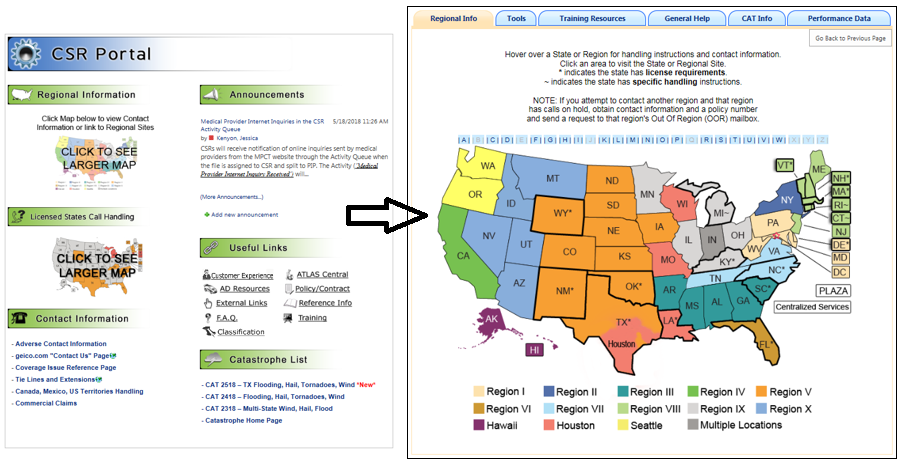
Interactive Resource Map
A custom HTML/CSS interface organized information into logical categories and visually grouped content by topic area.
Hover-Based Information Display
Associates could view descriptions and contextual information without leaving the page.
Direct Resource Access
Links were embedded throughout the interface, minimizing unnecessary navigation and reducing the number of clicks required to reach desired content.
Centralized Knowledge Repository
Training materials, newsletters, job aids, reference guides, and operational resources were organized into a single destination.
Performance Support Resources
Frequently used references and just-in-time learning tools were positioned prominently for rapid access.
Example of the interactive design architecture used to support navigation and learner engagement within the Enterprise Knowledge Hub. Proprietary content has been removed for portfolio presentation.
Design Decisions
Several deliberate design choices supported usability and performance:
Keep Associates on the Main Page
Rather than requiring users to navigate through multiple subpages, the majority of information was accessible through interactive elements directly on the homepage.
Visual Organization
Content was grouped according to how associates performed work tasks rather than by department ownership.
Progressive Disclosure
Hover interactions provided additional context only when needed, reducing clutter while maintaining information availability.
Reduced Click Paths
Frequently accessed resources were intentionally surfaced to reduce navigation time and improve efficiency.
Results
The Enterprise Claims Knowledge Hub created a centralized destination for claims learning and operational resources that:
- Consolidated information previously maintained across 11 regional offices
- Improved resource accessibility
- Reduced time spent searching for information
- Increased consistency of available guidance
- Supported just-in-time learning and performance support
- Simplified maintenance and governance of knowledge resources
The project transformed a fragmented collection of independent resources into a scalable knowledge-management system that better supported both new and experienced associates.
